

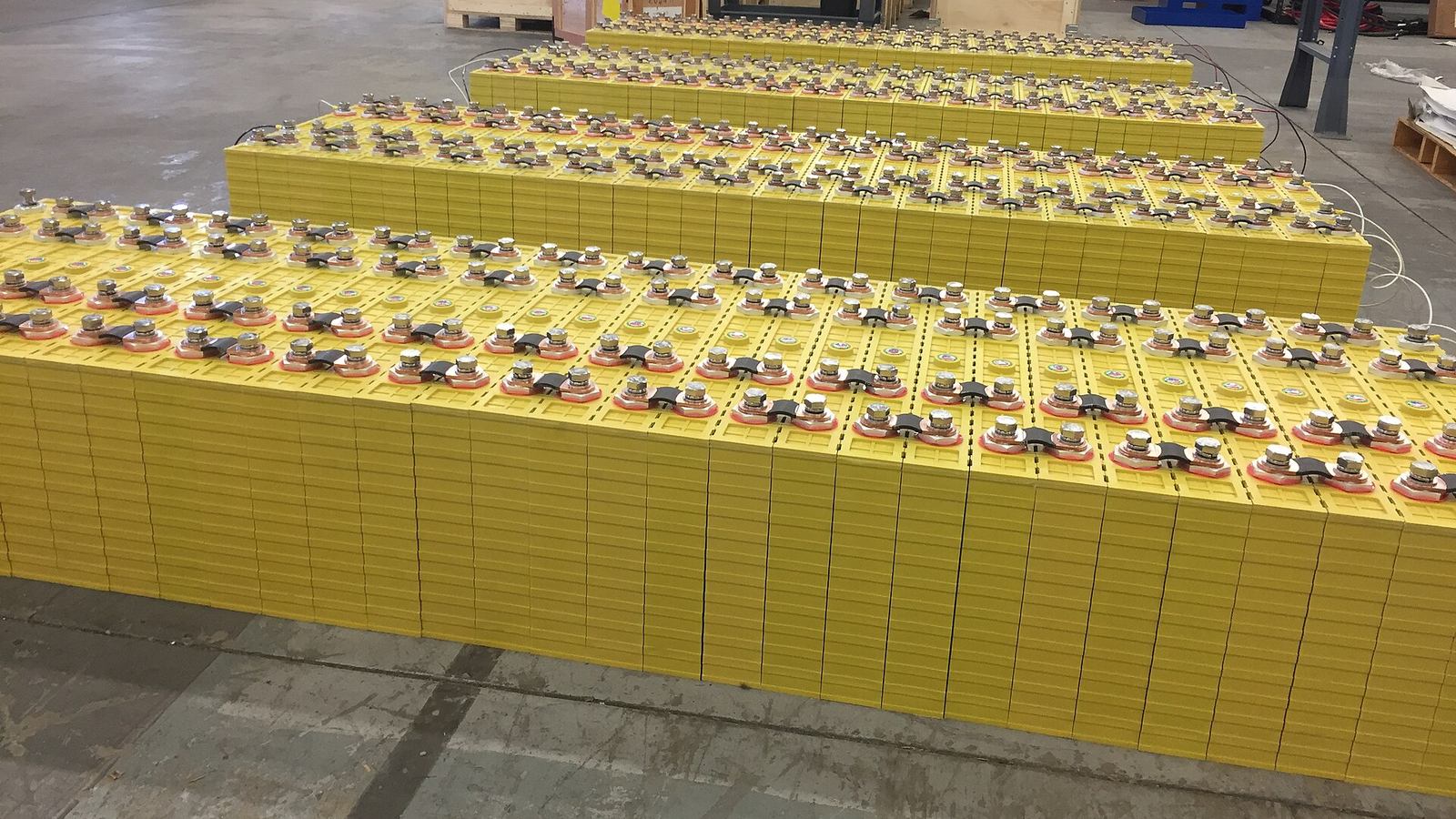
BESS procurement cost in 2026 is no longer one quoted number. It is three lines that move independently: the China transaction price, the Section 301 duty that rose to 25% on 1 January 2026, and the ocean freight that carries the containers. InfoLink put a 4-hour AC-side containerized system at RMB 0.53/Wh on 21 October 2026, which is US$78.9/kWh at the PBOC central parity rate of 6.7192 for the same day. Apply the duty and a Transpacific container and the same hardware lands near US$100/kWh. Buyers still budgeting from the ex-works number are understating the project by more than a quarter.
Ask for a Landed-Cost Sheet, Not an Ex-Works Price
Send the duration, the site country and the target delivery window. We return a DDP or FOB breakdown with the equipment, duty, freight and warranty lines separated.
What Does BESS Procurement Cost Per kWh in 2026?
The arithmetic fits on one line: take the China transaction price in RMB per watt-hour, divide by the exchange rate, multiply by 1.25 for the Section 301 duty, then add freight per kWh. InfoLink’s 21 October 2026 assessment supplies the input prices. Drewry’s World Container Index supplies the ocean leg, at US$8,007 per 40ft container from Shanghai to Los Angeles on 22 October 2026. A 40ft container carries roughly 5 MWh of racks, so the freight line works out at about US$1.60/kWh.
| Configuration (China transaction price) | RMB/Wh | Ex-works US$/kWh | After 25% duty | Landed US$/kWh |
|---|---|---|---|---|
| 1-hour AC-side containerized | 0.84 | 125.01 | 156.27 | 157.87 |
| 2-hour AC-side containerized | 0.58 | 86.32 | 107.90 | 109.50 |
| 4-hour AC-side containerized | 0.53 | 78.88 | 98.60 | 100.20 |
| 2-hour DC-side containerized | 0.49 | 72.93 | 91.16 | 92.76 |
| CNNC award, low end | 0.4995 | 74.34 | 92.92 | 94.53 |
| CNNC award, high end | 0.5329 | 79.31 | 99.14 | 100.74 |
Freight is the flat line in that table: at about US$1.60/kWh it adds less than 2% to a 4-hour system, so the landed column is the duty figure plus that one item. Read the last column, not the first. The 4-hour AC-side system lands at US$100.20/kWh, the 2-hour at US$109.50 and the 1-hour at US$157.87. The DC-side figure looks cheapest at US$92.76, but that scope stops at the DC bus, so the PCS, transformer and medium-voltage switchgear still have to be bought separately. Compare like scopes or the table will flatter the wrong option.
How Much Does the 25% Section 301 Tariff Add?
The duty is the largest single add-on, and it is no longer a forecast. Foreign entity of concern restrictions and the scheduled Section 301 increase to 25% on Chinese-origin BESS both took effect on 1 January 2026, as Energy-Storage.news reported. On a 4-hour system at US$78.88/kWh that is US$19.72/kWh of duty before anything moves. Clean Energy Associates had estimated in 2024 that the tariff package would lift integrator costs by 11% to 16%, an assessment written before the 25% rate took effect. That is why the sourcing structure, not the unit price, is now the negotiation that decides the outcome; the compliant sourcing route for 2026 tariffs is worth mapping before the RFQ goes out.
Why Do 1-Hour Systems Cost 58% More per kWh Than 4-Hour?
Duration, not chemistry, drives the spread. A 1-hour AC-side container costs RMB 0.84/Wh against RMB 0.53/Wh for a 4-hour unit, a 58% premium per kilowatt-hour, because the PCS, transformer, switchgear, fire suppression and enclosure are spread over one hour of energy instead of four. The premium is rational when revenue comes from a capacity or ancillary-service payment that pays for megawatts rather than megawatt-hours, and wasteful when revenue is arbitrage. Fix the revenue stack first, then choose duration; the reverse order is how projects end up overpaying for power electronics they rarely use.
What Did the CNNC 2.98 GWh Tender Reveal About Pricing?
The largest transparent data point of the month is the China National Nuclear Corporation award. On 14 October 2026 CNNC announced results for its 2026 to 2028 corporate-level LFP ESS procurement, about 2.98 GWh, with 33 companies bidding and quotes clustered between RMB 0.4995/Wh and RMB 0.5329/Wh. Sungrow, CATL, ZTT Energy Storage, CRRC Zhuzhou Institute and Kehua Digital Energy won. InfoLink notes that the scope is equipment supply rather than a turnkey EPC contract, so the range is a clean read on hardware pricing. Landed at a US site with duty and freight, it becomes US$94.53 to US$100.74/kWh. The same tender pattern is why duration now outranks headline dollars in tender scoring.
Where Do Lithium and Cell Prices Go Next?
Raw material is still falling, which argues against locking a full year at today’s price. Battery-grade lithium carbonate averaged RMB 102,000/tonne on 21 October 2026, down 6.4% week on week, and spodumene concentrate sat at US$1,500/tonne CIF. The 280 Ah and 314 Ah LFP cells that dominate utility-scale projects averaged RMB 0.358/Wh, down 0.7%, and cells are now about 67.5% of a 4-hour AC system’s price, so lithium remains the biggest single cost driver. Two counterweights: a consumption tax on lithium-ion batteries took effect in September 2026, and changes to export tax rebates are pulling orders booked for the first quarter of 2027 into the fourth quarter of 2026. See where the lithium price trend and the shift to 500 Ah and larger cells leave the cell line.
How Should a Buyer Structure the 2026 Procurement?
Sequence the decisions. Fix duration and grid-forming requirements first, because they set the PCS rating and the price per kWh more than any negotiation does. Then fix scope: DC-side blocks plus separate PCS, a full AC-side container, or a turnkey package with medium-voltage work. Then fix the trade term. A DDP price hides duty and freight inside one number, which is comfortable until the rate changes; an FOB or CIF price exposes them, which is what a 25% duty environment rewards. Lock cell supply separately from integration when the schedule is long, put the cell format and the cell maker into the contract, and price a spare-parts and augmentation allowance into the same document. Finally, test lead time against the export-rebate pull-forward, because capacity booked for early 2027 may already be committed. A procurement cost sheet that omits any of those lines is a price, not a budget.
What Revenue Must the Asset Earn to Justify the Cost?
Cost only matters against revenue. In PJM, the 2026/2027 base residual auction cleared at US$329.17 per megawatt-day, the price cap written into the market’s FERC-approved tariff, and that is the figure a storage owner underwrites against. At that level a 100 MW system earns about US$12.0 million a year in capacity revenue before any derate, enough to carry a large share of a US$100/kWh build. That is the argument for paying for 4-hour duration and grid-forming capability instead of the cheapest block on the table.
The useful next step is a landed-cost sheet rather than a brochure. Send the duration, the site country, the target commercial operation date and the interconnection status, and we will return equipment, duty, freight and warranty as separate lines priced against the 21 October 2026 market. Start with the utility-scale BESS range for front-of-meter work, the containerized BESS platforms for fast deployment, or the commercial and industrial ESS line if the load sits behind the meter. For a duration-by-duration comparison, the 2026 containerized BESS cost breakdown uses the same inputs.
What is a realistic BESS procurement cost in 2026?
For a 4-hour AC-side containerized system, China transaction prices averaged RMB 0.53/Wh on 21 October 2026, which is US$78.88/kWh at the PBOC central parity rate of 6.7192. Add the 25% Section 301 duty and about US$1.60/kWh of Transpacific freight and the landed figure is near US$100.20/kWh. A 1-hour unit lands at US$157.87/kWh and a 2-hour at US$109.50/kWh.
How much does the Section 301 tariff add to a BESS?
The rate on Chinese-origin BESS rose to 25% on 1 January 2026, alongside foreign entity of concern restrictions. On a 4-hour system priced at US$78.88/kWh the duty alone is US$19.72/kWh, roughly a fifth of the equipment value, before any freight or logistics cost.
Why is a 1-hour BESS so much more expensive per kWh?
Because the fixed hardware is spread over less energy. A 1-hour AC-side container costs RMB 0.84/Wh against RMB 0.53/Wh for a 4-hour unit, a 58% premium per kWh, since the PCS, transformer, switchgear, fire suppression and enclosure are the same either way. Short duration only pays when revenue is capacity-based rather than energy-based.
Is now a good moment to lock LFP cell supply?
Prices are still drifting down. Battery-grade lithium carbonate averaged RMB 102,000/tonne on 21 October 2026, down 6.4% week on week, and 280 Ah and 314 Ah cells averaged RMB 0.358/Wh, down 0.7%. But a consumption tax on lithium-ion batteries started in September 2026 and export rebate changes are pulling first-quarter 2027 orders forward, so availability, not price, is the near-term risk.
Should a BESS buyer contract DDP or FOB?
In a 25% duty environment, FOB or CIF is easier to audit because duty and freight stay visible and can be challenged or restructured. DDP is simpler to budget but hides the tariff inside one number, so ask for the duty line separately even when the quote is DDP.