

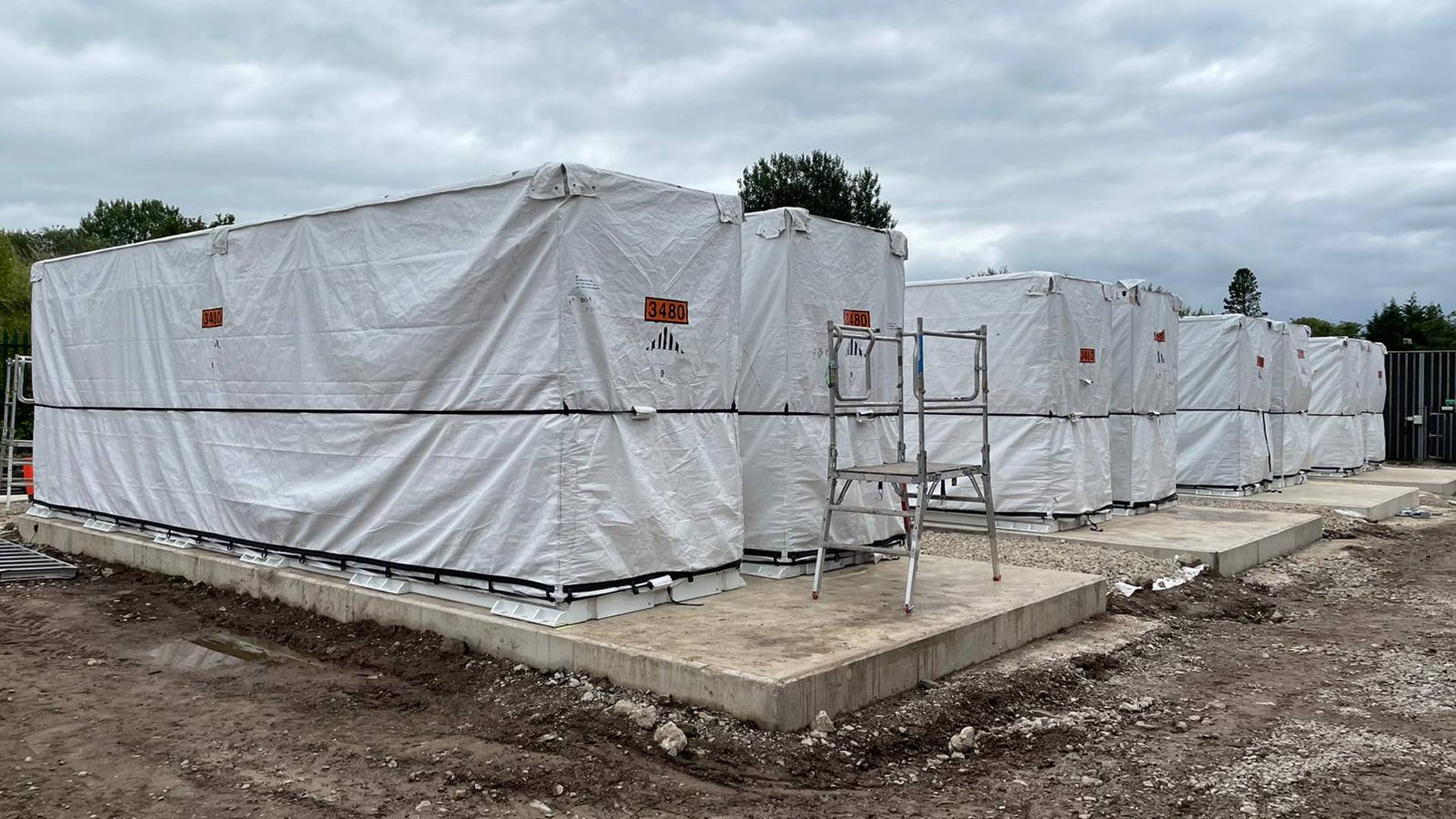
Containerized BESS cost in 2026 is no longer a black-box negotiation. Buyers from Africa to Europe are asking for a BESS price per kWh they can plug into a utility-scale battery storage model, and Chinese supply chains are finally treating the 20-foot liquid-cooled battery container as a standard commodity. This guide breaks down the real numbers behind a 2026 quote: cell costs, container integration, AC equipment, regional delivery premiums and the certifications that separate a bankable system from a grey-market box.
Get a 2026 Containerized BESS Quote
Get your 2026 containerized BESS cost estimate on WhatsApp or request a written quote by email.
Why 2026 Is a Buyer’s Market for Containerized BESS
Three forces have reset pricing. BloombergNEF’s December 2025 Lithium-Ion Battery Price Survey put global lithium-ion pack prices at a record $108/kWh, while stationary storage packs fell 45% year-on-year to $70/kWh. BNEF expects pack prices to edge down further in 2026, to roughly $105/kWh, even as metal costs, tariffs and grid-forming inverter requirements push back. At the same time, the 314Ah lithium iron phosphate (LFP) cell has become the default storage cell, allowing a single 20-foot container to hold roughly 5 MWh—almost double the density of older air-cooled 3.44 MWh units. That density cut slashes shipping, cabling and civil-work costs per megawatt-hour and lowers the cost per megawatt of delivered capacity. Third, SMM launched weekly FOB-China price benchmarks for 5MWh DC-side battery containers on 26 June 2026, covering exports to Europe and India, giving buyers an independent reference for the first time.
What Does a 2026 Containerized BESS Include?
A “containerized BESS” is not just a box of cells. The bill of materials has six layers. Grade-A prismatic LFP cells (usually 314Ah) make up the largest cost share. A three-tier battery management system (BMS) monitors voltage, current and temperature at module, cluster and container level. A power conversion system (PCS) and inverter turn DC battery power into grid AC. An energy management system (EMS) dispatches the plant. Liquid-cooling HVAC keeps cell-to-cell temperature spread below 4 °C, extending cycle life. Finally, fire suppression, arc-fault protection and an IP55/C5 enclosure meet shipping and site-safety rules. Skipping any of these shows up later as warranty fights or stranded assets. NEGUP’s containerized BESS platforms ship every layer pre-integrated.
How Much Does a Containerized BESS Cost in 2026?
The table below uses live 2026 inputs to build a battery storage quote you can compare against supplier offers. Cell prices come from InfoLink (314Ah LFP at RMB 0.363/Wh on 8 October 2026), SMM and Mysteel. System ranges are anchored on SMM’s June 2026 FOB-China 5MWh DC-block benchmarks and CNESA DataLink’s August 2026 Chinese tender average of $83–104/kWh. These are ex-works or FOB figures; landed, installed prices depend on duties, freight and local labor.
| Cost layer | Typical 2026 price | What it covers | Reference |
|---|---|---|---|
| LFP cell (314Ah, EXW China) | ~$52–58/kWh | Prismatic LFP cells only | InfoLink / SMM / Mysteel |
| DC battery container (5MWh, FOB China) | ~$71–89/kWh | Cells + BMS + thermal + IP55 enclosure | SMM / coloprice |
| AC integrated block with PCS (ex-works China) | ~$90–130/kWh | DC container + 2.5MW PCS + EMS | Industry benchmarks |
| Utility-scale BESS delivered Asia / Middle East | ~$120–145/kWh installed | Equipment + freight + local civil work | anengjipower |
| Utility-scale BESS delivered Europe | ~$150–210/kWh installed | Higher labor and grid-connection costs | anengjipower |
| Utility-scale BESS delivered United States | ~$180–260/kWh installed | Tariffs; IRA tax credits can offset net cost | anengjipower |
Why Did the 5 MWh Liquid-Cooled Container Become the 2026 Benchmark?
Until 2024 the standard 20-foot container held 2.5–3.5 MWh of air-cooled cells. The shift to 314Ah LFP and liquid cooling has pushed the same footprint to 5.0–5.015 MWh. A typical 5 MWh battery container uses 48 modules of 104 cells, a nominal DC voltage around 1,331 V, and a weight near 43 tonnes. SMM’s June 2026 price launch for “Energy Storage Battery Stack – 5MWh” explicitly tracks this class for Europe and India, with CATL, EVE, Envision, Hithium, Hyperstrong and others listed as reference brands. The bigger container matters because it cuts containers-per-megawatt-hour by roughly 35%, reducing transport, site cabling and concrete pads. Much of this gain traces back to the LFP cell price collapse and the jump from 280Ah to 314Ah formats.
What Pushes Your Containerized BESS Price Up or Down?
Duration matters: a 4-hour system needs less PCS per MWh than a 2-hour system, so the per-kWh price falls as duration grows. Certification stack matters: UL 9540A, IEC 62619, IEC 63056 and local grid codes add engineering and testing cost. Cell grade matters: Grade-B or mixed cells can knock $10–20/kWh off a quote but void bankability. Tariffs, BESS shipping cost and logistics matter: China’s battery VAT rebate dropped from 13% to 6% in April 2026 and will disappear in 2027, raising the export cost base. Finally, AC versus DC coupling matters: an AC block with a built-in PCS is simpler to retrofit, while a DC-coupled solar-plus-storage design saves one inverter stage. Understanding these levers is the fastest way to cut the commercial and industrial ESS price without cutting reliability.
How to Read a 2026 BESS Quote and Avoid Grade-B Cells
Before comparing prices, ask for a line-item bill of materials with cell supplier, cell model, cycle-life test conditions, BMS architecture, PCS brand and EMS functions. Check that IEC 62619, UN38.3, IEC 62477 and UL 9540 or IEC 63056 are named in the quote, not just mentioned in a brochure. Confirm whether the price is EXW, FOB, CIF or DDP, because freight and import duties can add 15–40% to the ex-works figure. Ask for a throughput warranty in writing: ten years or 8,000 cycles is the floor for a bankable LFP system. If the supplier cannot name the cell batch or grade, that is a signal to walk away.
How to Get a 2026 Containerized BESS Quote from NEGUP
NEGUP supplies utility-scale BESS platforms from 500 kWh to multi-megawatt blocks for EPCs, integrators and industrial buyers. We quote the DC container, AC block, PCS, EMS, shipping and commissioning as separate line items so you can see exactly where the cost sits. SNE Research reported global energy-storage battery shipments of 461.3 GWh in the first half of 2026, up 71% year-on-year, confirming that containerized BESS cost compression is a volume story, not a one-off discount. For a 2026 budget tailored to your project, send your load profile, target duration and delivery country.
Buyer FAQ: Containerized BESS Cost in 2026
Is $80/kWh realistic for a containerized BESS in 2026?
Yes, for a 5MWh DC-side battery container FOB China. Turnkey installed prices are higher once freight, import duties, PCS, EMS, civil work and commissioning are added.
Does the price include shipping and import duty?
Not unless the quote explicitly states CIF or DDP. Most Chinese factory quotes are EXW or FOB, so you should budget 15–40% above the equipment price for logistics, duties and local installation.
What duration gives the lowest $/kWh?
Four-hour systems usually show a lower $/kWh than two-hour systems because the same PCS serves more stored energy. Beyond six hours, other technologies may start to compete.
Can I supply my own cells for a NEGUP container?
Yes, provided the cells are Grade-A prismatic LFP, pass IEC 62619 and UN38.3, and come with batch-test data. NEGUP integrates the BMS, thermal, fire suppression and enclosure around your approved cells.
How long is the lead time for a 5 MWh container?
Lead time typically ranges from three to six months from contract signing, depending on cell allocation, factory loading and the destination port. Early booking secures both price and slot.