

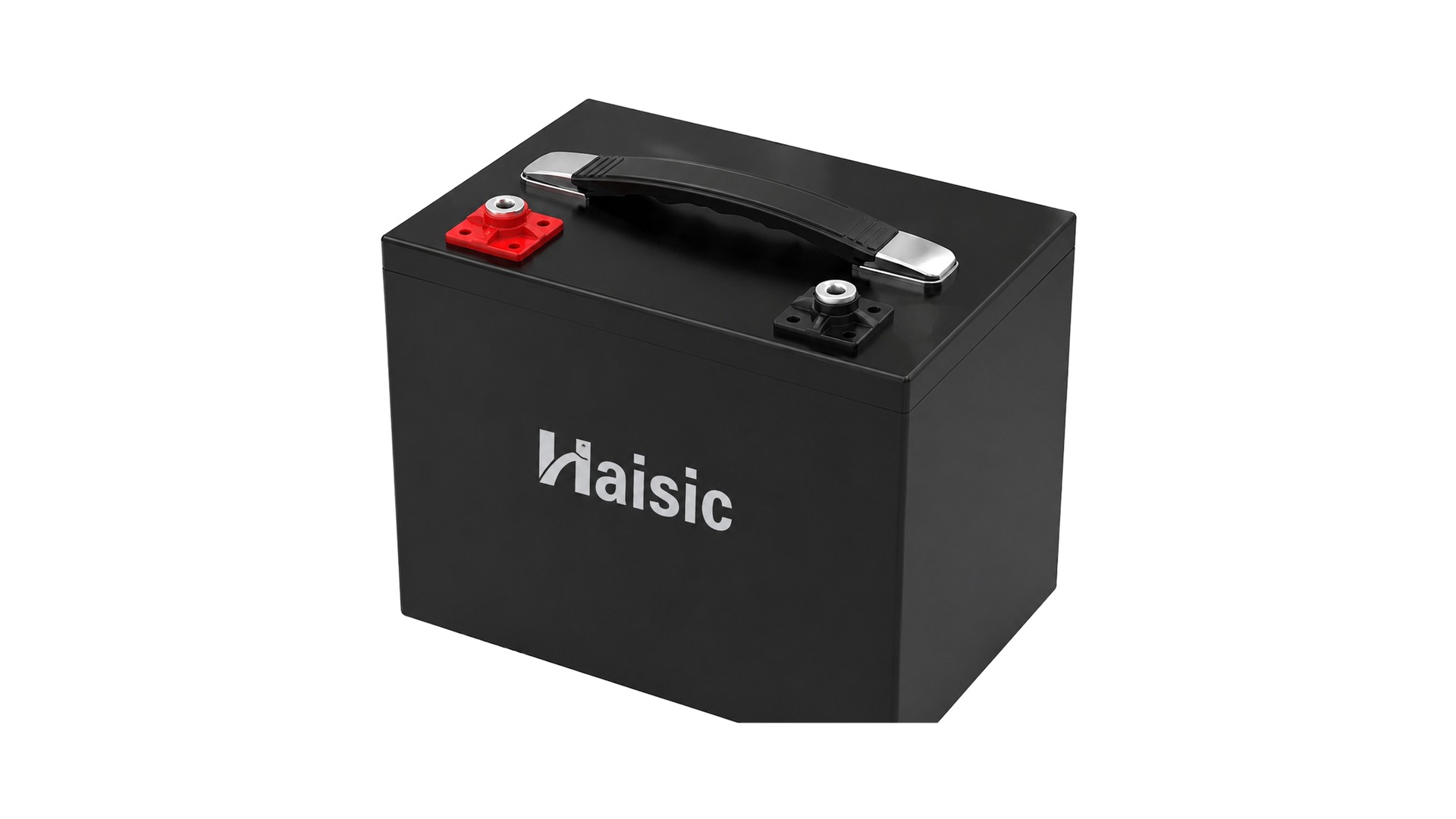
A 12V 100Ah LiFePO4 battery stores 1.28 kWh and gives back about 1.15 kWh at 90% depth of discharge. That is enough to carry a 60 W LED street light through a 12-hour tropical night twice over with no sun at all, which is why this block has become the default line item in Nigerian street lighting bills of quantity. The three things that go wrong are always the same: the pack is sized from the lamp wattage instead of the nightly energy, the enclosure cooks it at 55 °C, and the import file is prepared after the container has sailed. This guide fixes all three with numbers you can paste into a purchase order.
Size the Pack Before You Order the Poles
Send us the lamp wattage, the dimming profile and the autonomy days your tender requires. We return the battery capacity, panel size and a landed-cost estimate for Lagos within 48 hours.
Solar street light battery
Nigeria import duty
SONCAP certificate
FOB price 2026
What Does a 12V 100Ah LiFePO4 Battery Actually Deliver?
Four LFP cells in series give 12.8 V nominal, so 100 Ah is 1,280 Wh — not the 1,200 Wh you get by multiplying 12 V by 100 Ah. Full stop. The number that decides how the light behaves is usable energy: 1,152 Wh at 90% DOD, 1,024 Wh at 80%. A supplier who quotes “100Ah” with no DOD and no test temperature is quoting a label, not a product, and that is where most street-light tenders start to drift.
Amp-hours do not transfer between chemistries either. A 100 Ah AGM discharged to 50% delivers about 600 Wh, and less than that under load because of the Peukert effect. The LFP pack with the same nominal amp-hours delivers nearly twice the energy. This single comparison error runs through most public lighting specifications in West Africa, and it is the reason a “like-for-like” swap from lead-acid to lithium usually comes back with a smaller, cheaper pack that performs better.
| Parameter | Typical 12V 100Ah LFP | What to write into the PO |
|---|---|---|
| Nominal energy | 12.8 V × 100 Ah = 1,280 Wh | Wh at 0.2C discharge, 25 °C |
| Usable energy | 1,152 Wh at 90% DOD | The DOD you will actually cycle to |
| Charge voltage | 14.2–14.6 V CC/CV | Absorption and float set-points for the controller |
| Discharge cut-off | 10.0–10.8 V | BMS cut-off, not just controller setting |
| Continuous charge current | 20 A comfortable, 50 A max | 0.2C preferred for street-light duty |
| Cycle life | 4,000–6,000 at 80% DOD, 25 °C | Cycles at your DOD and your ambient |
| Charge temperature | 0 to +45 °C | Low-temperature charge cut-off required |
| Discharge temperature | −20 to +60 °C | Derating above 45 °C |
| Weight | 11–13 kg | Pole load and handling |
| Self-discharge | Under 3% per month | Storage and shipping state of charge |
Ask for the discharge curve at 0.2C and 25 °C before you approve a sample. A 100 Ah pack that delivers 96 Ah at 0.2C and 78 Ah at 1C is entirely normal; the curve tells you which one you are buying. NEGUP builds 12.8 V LiFePO4 battery packs on exactly this 4S platform, so the cells, BMS logic and test method are the same whether you specify 15 Ah or 100 Ah.
How Many Nights Will One Battery Carry a Street Light?
Street lights rarely run at full power all night. Most 2026 controllers run a profile such as 100% for five hours after dusk, then 40% for the remaining six. Size from the profile, not the nameplate, and the required energy drops by about a third — which is often the difference between a 100 Ah and a 150 Ah pack.
| LED load | Energy per night 5 h at 100%, 6 h at 40% |
Nights from 1,152 Wh usable | Practical pack |
|---|---|---|---|
| 30 W | 222 Wh | 5.1 | 12V 60Ah |
| 40 W | 296 Wh | 3.9 | 12V 100Ah |
| 60 W | 444 Wh | 2.6 | 12V 100Ah |
| 80 W | 592 Wh | 1.9 | 12V 150Ah |
| 100 W | 740 Wh | 1.6 | 12V 200Ah or 24V 100Ah |
So a single 12V 100Ah pack gives a 60 W lamp about 2.5 nights of autonomy. If your specification demands the usual three to five cloudy nights, one 100 Ah unit is not enough: step to 150–200 Ah, accept two nights with grid or genset backup, or deepen the after-midnight dimming to 30%. Tender clauses that read “60 W, 100 Ah, five days autonomy” are internally inconsistent, and the battery is what gets blamed when the light goes dark on the third overcast night.
Above 80 W, or wherever several poles share one battery bank, move to 24 V. Half the current means thinner cable, less voltage drop and a cheaper BOM for the same watt-hours — the 25.6 V 280Ah LiFePO4 pack covers that layout without paralleling four 12 V units and hoping the BMS boards agree.
Lead-Acid or LiFePO4 at One Cycle a Night?
A street light cycles once a day, 365 times a year, and that is precisely the duty a lead-acid battery handles worst. A 100 Ah AGM cycled to 50% DOD returns roughly 400–600 cycles before it falls to 80% of rated capacity — around 15 months of nightly service. Over eight years that is five or six replacements, and every one of them is a pole climb, a haulage cost and a return site visit.
| At one cycle per night | 12V 100Ah AGM | 12V 100Ah LiFePO4 |
|---|---|---|
| Usable energy | 600 Wh (50% DOD) | 1,152 Wh (90% DOD) |
| Cycles to 80% capacity | 400–600 | 4,000–6,000 |
| Replacements in 8 years | 5–6 | 0–1 |
| Weight per unit | 30–33 kg | 11–13 kg |
| Charge efficiency | about 85% | about 97% |
| Indicative FOB China, Q4 2026 | USD 95–125 | USD 145–195 |
LiFePO4 costs about 1.5 times as much at the order and roughly a third as much across the life of the pole. Two secondary effects matter more in West Africa than the spreadsheet suggests: 12 kg instead of 31 kg reduces wind load on a six-metre pole and makes a two-person install safe, and 97% charge efficiency instead of 85% means the panel can be one size smaller for the same nightly energy. Confirm the current spread with a quotation rather than a table — cell and freight prices moved repeatedly through 2026.
Which Temperature Decides Whether It Survives?
LFP cannot be charged below 0 °C. Plating lithium onto the anode causes damage that no balancing cycle repairs. In Nigeria that limit is not the risk; heat is. A black steel pole-top box in Kano or Maiduguri reaches 50–60 °C internally in April, and calendar ageing roughly doubles for every 10 °C above 25 °C. A pack rated 6,000 cycles at 25 °C is not a 6,000-cycle pack at 55 °C — expect 2,500–3,000, which is still about seven years at one cycle a night, but price it honestly instead of quoting the laboratory figure.
Four cheap fixes cost almost nothing at the design stage: mount the pack beneath the lamp head rather than above it, use a light-coloured or ventilated enclosure with a breather membrane instead of a sealed black box, keep the BMS temperature sensor against the cells rather than on the lid, and set a charge derating above 45 °C in the controller. Harmattan dust is the other half of the problem — a soiled panel loses 10–20% of its yield between December and February, so size the array for the dirty case and never for a clean one.
If you also supply cold or high-altitude markets, specify the self-heating variant. A film heater plus a BMS that blocks charging below 0 °C until the cells reach 5 °C solves the winter failure mode in the same 12V 100Ah footprint. It is the same cell stack with a different control board, so it can be mixed into a fleet order without changing brackets or cable.
How Do You Size the Panel and the Controller?
Daily energy times 1.3 for losses, divided by peak sun hours. For the 60 W example: 444 × 1.3 ÷ 4.0 = 144 Wp in theory. Add 30% for dust, cable drop and end-of-life, and 200–250 Wp is the practical answer. Nigeria runs about 4.5–5.5 peak sun hours on a clean panel in the north and 3.5–4.0 in the humid south during the rains; use 4.0 whenever the site is unknown.
Use MPPT, not PWM. A 250 Wp panel with a 36 V maximum-power voltage feeding a 12 V battery through a PWM controller throws away close to a third of the array, and an MPPT unit recovers most of it inside one season. A 20–30 A controller covers 250–300 Wp at 12 V, and the resulting charge current of about 17 A is 0.17C — comfortably inside the band a 100 Ah LFP pack prefers.
Keep the DC run short and thick: 2.5 mm² copper up to 3 m at 20 A, 4 mm² beyond that, fused at the battery terminal. One volt of drop on a 12 V system is 8% of your energy gone before it ever reaches the cells, which is exactly the kind of loss that gets misdiagnosed as a weak battery in month two.
Nigeria Import 2026: Which Duty and VAT Actually Apply?
Start with the trap, because it catches most first shipments. Solar panels clear under HS 8541.42 and 8541.43, where the 0% ECOWAS CET rate and the VAT zero-rating claimed under Section 144 of the Nigerian Tax Act and Customs Circular T&T/2024/18 are routinely quoted. A 12V 100Ah battery is not a 8541 item. It is a lithium-ion accumulator under HS 8507.60.00, and the treatment is different.
What can be evidenced for 2026: duty on 8507.60 is quoted anywhere between 0% and 5% by clearing agents. The Nigeria Customs handbook for renewable-energy goods carries a 20% lithium line in its annex, but that line sits under 8506.50.00 — primary lithium cells, a different product. If an agent applies 20% to your LFP pack, that annex row is usually the reason. VAT is 7.5% on ordinary imports; the renewable-energy zero-rating is written for solar equipment, and batteries sit at the edge of that definition. Confirm the HS code and the VAT treatment in writing before you model margin, and check the 2026 Fiscal Policy Measures published by the Nigeria Customs Service, because the tariff schedule was amended this year.
Here is what the difference is worth on a real shipment. Two hundred 12V 100Ah units at USD 148 FOB, plus USD 1,260 freight and insurance, gives a CIF of USD 30,860. Duty at 5% is USD 1,543; the 1% CISS and 0.5% ETLS levies add USD 463; clearing, terminal handling and haulage to a Lagos warehouse add USD 480. That lands at USD 166.70 per unit before VAT, which is recoverable if you are VAT-registered. Confirm 0% on the same shipment and it lands at USD 159.00 — a 4.6% swing, about USD 7.70 a unit. Worth getting right, not worth a two-week detention to argue at the port.
Two further lines importers report as unsettled: the 4% FCS levy, whose application status is still being clarified, and the 1% CISS treatment on renewable-energy goods. Carry both as contingency rather than as a confirmed cost, and ask your agent to name the fiscal-policy measure behind each line on the assessment.
If you assemble rather than import finished packs, note that the EDTI replaced Pioneer Status in January 2026 and pays a 5% annual tax credit on qualifying capital expenditure in renewable energy, including storage. That is a credit against tax liability, not an exemption, but it changes the arithmetic when you compare importing 12V 100Ah units against building them locally from cells.
SONCAP, UN38.3 and the Paperwork That Clears Lagos
Duty and conformity are separate regimes, so a zero-duty line does not remove SONCAP. Non-automotive batteries under HS 8506 and 8507, excluding 8507.10, are regulated products: you need a Product Certificate registered to the model and the manufacturer, plus a Shipment Certificate for every consignment, issued after pre-shipment inspection. Since 27 March 2026 the National Single Window integrates SONCAP and Form M, which means an incomplete file stalls earlier — prepare it before the container leaves, not after it berths.
Document pack for a battery container
- UN38.3 test summary report, not only the certificate cover sheet
- MSDS/SDS at the current revision, matching the exact cell chemistry shipped
- IEC 62619 report for the pack; IEC 63056 if it is declared as a stationary system
- 1.2 m drop test and PI 965 Section II packing for Class 9, UN3480
- Product Certificate number quoted on the commercial invoice and packing list
- Form M and PAAR opened before shipment, not at the port
- NEMSA check where the installation is grid-connected — most street lights are not, but state projects sometimes ask
Missing paperwork shows up as demurrage, and demurrage at Apapa or Tin Can Island runs 2–4% of landed cost in a bad month. A container that waits three weeks costs more than the duty you were trying to avoid, and it costs it in the season when the poles are already installed.
What Should the Purchase Order Say?
Vague purchase orders are how a 100 Ah pack becomes a 92 Ah pack by the time it reaches the site. Ten lines fix it:
Specification lines that survive the factory
- Nominal energy in Wh, at 0.2C discharge and 25 °C, with the DOD stated next to it
- Cycle life at that DOD, plus the capacity-retention curve at years 1, 3 and 5
- BMS continuous current, low-temperature charge cut-off, cell-level balancing, and comms if the fleet is monitored
- Charge and discharge temperature windows written as numbers, not as “wide range”
- Terminal type (M8 on most 100 Ah units), torque value, and whether a lifting handle is fitted
- IP rating of the pack and of the enclosure it sits in — these are two different numbers
- Case material and flame-retardant grade
- UN38.3, MSDS and IEC 62619 listed as deliverables, not as “available on request”
- Warranty term, and the exact conditions that void it: opened case, third-party BMS, over-temperature log
- Spare BMS boards for fleet orders, priced inside the same quotation
Everything above is what our own LiFePO4 battery range is quoted against, and the same sheet works for tendering against other suppliers — which is the point. If you are weighing chemistry before you choose a block size, the manufacturing-side comparison in our LiFePO4 solar street light battery buyer guide covers cell format and cold-climate behaviour in more depth than a procurement page should.
Get a Landed-Cost Quote, Not Just an FOB Price
Tell us the destination port, the unit quantity and whether you import as a distributor or a project developer. We return FOB, CIF and an indicative Lagos landed cost with the HS code we would declare, so your agent has something to argue with.
Frequently Asked Questions
How much energy does a 12V 100Ah battery actually store?
1,280 Wh nominal at 12.8 V, of which about 1,152 Wh is usable at 90% depth of discharge. If you compare it with a 100 Ah lead-acid battery, use 600 Wh for the lead-acid side: that is what a 50% DOD limit leaves you, before load-related losses.
Will one 12V 100Ah battery run a 60 W street light all night?
Yes, and for about 2.5 nights without sun if the controller runs a 5-hour full / 6-hour dimmed profile. At a flat 60 W for eleven hours the same pack gives 1.7 nights, so the dimming profile is what buys the autonomy. For three to five cloudy nights, step up to 150–200 Ah.
Should I use 12V 100Ah or 24V for street lighting?
12 V is sufficient up to about 80 W per pole and keeps the controller and cable choice simple. Above 80 W, or when several poles share a battery bank, 24 V halves the current, reduces cable size and voltage drop, and costs less per kilowatt-hour than paralleling four 12 V units.
Is a 12V 100Ah LiFePO4 battery duty-free in Nigeria in 2026?
Not automatically. The 0% rate widely quoted for solar applies to panels under HS 8541.42 and 8541.43. A battery is classified under HS 8507.60.00, where agents quote 0–5% duty, and VAT is normally 7.5%. Confirm the code and the VAT treatment in writing against the current 2026 Fiscal Policy Measures before you price the shipment.
What is SONCAP and does a battery need it?
SONCAP is Nigeria’s pre-shipment conformity scheme. Non-automotive batteries under HS 8506 and 8507 are regulated products, so you need a Product Certificate for the model and manufacturer plus a Shipment Certificate for each consignment. Duty and conformity are separate regimes: zero duty does not mean no SONCAP.
Can lithium batteries be shipped to Nigeria by sea?
Yes, as Class 9 dangerous goods under UN3480, with a UN38.3 test summary, an MSDS, a 1.2 m drop test and PI 965 Section II packing. Book the space early: carriers restrict lithium volume per vessel, and a missed sailing costs more than the freight differential.
How long will a 12V 100Ah pack last in a hot climate?
Expect 2,500–3,000 cycles at 80% DOD in a 45–55 °C enclosure, against 4,000–6,000 in a laboratory at 25 °C. At one cycle a night that is still roughly seven years. Shading the enclosure, ventilating it and derating charge current above 45 °C are the three measures that recover most of the difference.