


A data center VPP used to be a thought experiment. In 2026 it is a financed, contracted line item. On 10 November 2026 Calibrant Energy closed a 145 million dollar facility led by Investec that includes a 120 megawatt-hour BESS for a hyperscale customer in PJM. Google and Voltus have moved to a 1 gigawatt flexible-capacity tranche funded by the buyer, not built by the utility. Singapore’s Energy Market Authority wants storage to grow from about 350 megawatt-hours to 1 gigawatt-hour by 2030. Each puts batteries, not servers, at the centre of getting a facility online. This article explains the storage side of that shift and what a buyer should verify.
Price the Battery Behind Your Grid-Interactive Site
Send your load profile, required ride-through duration and target grid service. We return an LFP BESS configuration with safety documents and a delivery schedule within 48 hours.
What Is a Data Center VPP, Exactly?
A data center VPP is a group of behind-the-meter batteries at computing facilities, coordinated so the sites can cut grid draw or discharge stored energy when the system is stressed. The hardware is familiar: LFP battery cabinets or containers, a power conversion system and an energy management controller. What changes is the control logic and the commercial contract. Part of the battery bank is reserved for IT ride-through, while another part is offered to an aggregator or utility for demand response, capacity or frequency services. A bank fully committed to backup cannot also sell flexibility, so buyers need the state-of-charge floor in writing rather than a brochure claim.
What Did Google and Voltus Commit to in PJM?
The clearest signal came from a partnership reported on 23 October 2026. Google and Voltus moved to phase two of an agreement funding 1 gigawatt of flexible capacity in PJM, up from 100 megawatts in June. The capacity is aggregated from distributed assets such as home and business batteries, with roughly 400 megawatts of distributed batteries expected in 2027. The reason is time: PJM is short about 6.8 gigawatts; new behind-the-meter gas turbines may not arrive until 2032, and nuclear uprates are expected between 2028 and 2034. Bilateral gas contracts imply roughly 400,000 dollars per megawatt-year. PJM dispatched its Emergency Load Response Program twice in one week in October, lifting the two-year total to 15 dispatches against eight between 2015 and 2024. The model brings capacity forward without waiting for a substation.
What Are Singapore and Asia Testing Right Now?
Singapore paired policy with a pilot. On 26 October 2026 the Energy Market Authority launched a storage vision and consultation to triple national storage from about 350 megawatt-hours to around 1 gigawatt-hour by 2030, with feedback open until 29 January 2027. It names three roles: reliability, managing demand where network capacity is tight, and coordinating smaller systems including through VPPs; larger systems may be centrally controlled. Four days later DayOne Data Centers and Blue Whale Energy signed a memorandum of understanding to study a distributed VPP linking batteries at DayOne’s SG1 facility with third-party commercial and industrial sites. Phase one is a front-end engineering design study covering configuration, safety, metering, telemetry and controls, plus possible Demand Response and Interruptible Load participation. This is a feasibility study, not a deployment: no megawatt rating, budget or timeline has been published.
Why Does On-Site Storage Make the Model Possible?
A computing load is unusual. Thousands of processors can move from idle to a synchronised burst, so the site sees step changes of tens of megawatts in milliseconds. A static grid feed must absorb that swing or trip its protection. A behind-the-meter battery bank can inject or absorb power far faster, holding grid draw inside the contracted limit. The same bank can shave a monthly peak, often the largest line on an industrial electricity bill. The engineering consequences are specific: high-rate cycling demands low internal resistance and tight cell-to-cell temperature control; liquid cooling is favoured over forced air for dense cabinets; every extra grid-service cycle consumes battery life. Buyers should ask how the controller arbitrates between a grid event and a ride-through event, and what the guaranteed reserve is after three years of daily dispatch.
How Much Storage Does a Grid-Interactive Facility Need?
Sizing follows the service, not the building. The figures below are engineering-typical RFQ ranges, not vendor quotes. Confirm each against the site load profile and local rules.
| Service | Typical duration | Power response | Battery duty | Ask the supplier for |
|---|---|---|---|---|
| Frequency response | Seconds to 15 minutes | Sub-second to seconds | High C-rate, shallow cycles, frequent reversals | Response-time test data and PCS rating |
| Demand-charge shaving | 1 to 2 hours | Seconds | Daily deep cycles, peak-window dispatch | Modelled savings against 12 months of bills |
| Interruptible load | 30 minutes to 2 hours | Minutes | Reserved capacity, limited cycle count | Documented state-of-charge floor |
| Capacity or deferral | 4 hours or more | Minutes | Long, slow discharges, high energy density | Degradation model over the contract term |
| IT ride-through | 5 to 15 minutes at full load | Sub-second | Ups reserve, priority over all grid services | Loaded test at the declared power factor |
| Hyperscale reference point | 4-hour class | Grid-scale | 120 MWh financed in PJM, November 2026 | Financing and interconnection evidence |
Which Standards and Controls Apply to a Data Center VPP?
The safety stack matches any multi-cabinet lithium installation. UL 9540 covers the system listing; the sixth edition of UL 9540A, published 13 March 2026, added installation-level large-scale fire testing for most non-residential systems. NFPA 855 sets separation and setback rules, while cell evidence comes from IEC 62619 or UL 1973, with UN 38.3 for transport. A bank that exports power adds an interconnection study and the utility’s inverter standard. The newer requirement is dispatch governance: Singapore’s consultation proposes operating requirements and central control for larger systems, and the DayOne study lists metering, telemetry and safeguards as first-phase work. Buyers need a controls architecture that honors a utility instruction without breaching the backup reserve, plus an auditable log of each dispatch.
What Does the Storage Cost in 2026?
Battery hardware is no longer the whole answer. InfoLink’s 11 November 2026 assessment put lithium carbonate near 89,000 renminbi per tonne, 314 ampere-hour LFP cells at 0.348 renminbi per watt-hour, a two-hour DC-side liquid-cooled container at 0.49, an AC-side two-hour container at 0.58 and a four-hour unit at 0.53. SMM reported a nearby carbonate average the same day; BloombergNEF’s stationary-pack benchmark sat near 70 dollars per kilowatt-hour. For a data center VPP the delivered cost also includes PCS, fire engineering, the control and telemetry layer, and the interconnection study — all quoted separately, and often decisive for flexibility revenue. Ask for a line-item breakdown rather than one price per kilowatt-hour.
What Should Buyers Confirm Before Ordering for a VPP Project?
Treat the purchase as a safety and control specification first. Confirm this list before signing:
Confirm these six points before ordering
- Reserve split. A written state-of-charge floor grid dispatch cannot consume, plus ride-through duration at full load.
- Fire evidence. The installation-level UL 9540A report with cabinet count, spacing, state of charge and suppression status, not a cell-level summary.
- Control handover. Who can issue a dispatch instruction, what latency is guaranteed, and whether a utility signal can override the site reserve.
- Metering and telemetry. The measured points, the data protocol, and who receives settlement data for grid-service revenue.
- Cycle budget. The assumed daily dispatch and the capacity guarantee over the contract term.
- Delivery and site works. Transport class, foundation and access limits, and lead time to a loaded test.
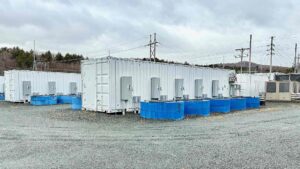
Compare the containerized BESS enclosures, utility-scale battery storage blocks and commercial and industrial ESS range before fixing the reserve split: the form factor decides which fire-tested configuration you buy.
The Buyer’s Questions, Answered
What is a data center VPP in simple terms?
It is a group of behind-the-meter batteries at or near data centres that are coordinated so the sites can draw less power, or discharge power, when the grid is under stress. The batteries still protect the IT load, but a control layer also exposes a portion of their capacity to a grid operator or aggregator. In 2026 the model has moved from concept to financed projects: Google and Voltus agreed a 1 GW flexible-capacity tranche in PJM, and DayOne and Blue Whale Energy signed an MOU on 30 October 2026 to study a distributed VPP in Singapore.
Does grid participation reduce the backup reserve for the servers?
It can, and that is the central engineering question. A battery bank has a finite state of charge, so any energy sold to the grid must be replaced before the next ride-through event. Buyers should ask for a written state-of-charge floor that is never dispatched, the discharge duration at full IT load, and the recharge time after a grid event. The DayOne and Blue Whale study explicitly covers operational safeguards and controls for this reason.
How much battery storage does a grid-interactive facility need?
There is no single number. The sizing follows the service: frequency response needs seconds and high power, demand-charge management needs one to two hours, and capacity or deferral products need four hours or more. A 120 MWh system was financed in November 2026 for one hyperscale customer in PJM. Treat that as evidence of scale, not a template; size from the site load profile, the contracted service and the reserve the operator is willing to commit.
Which certificates should a storage supplier provide?
Ask for the system listing and the fire-test evidence together: UL 9540 for the complete system, the UL 9540A installation-level report, cell and battery certificates such as IEC 62619 or UL 1973, and UN 38.3 transport summaries. For a site that exports power, add the interconnection study and the inverter standard required by the local utility. A certificate claim without a test report is not enough for a multi-cabinet bank.
What did the November 2026 battery prices actually say?
InfoLink’s 11 November 2026 assessment put 314 Ah LFP cells near 0.348 renminbi per watt-hour, a two-hour DC-side liquid-cooled container near 0.49 renminbi per watt-hour and an AC-side two-hour container near 0.58. BloombergNEF’s global stationary-pack benchmark was near 70 dollars per kilowatt-hour. Those figures cover hardware; PCS, fire engineering, controls and interconnection studies are quoted separately.
Sources: Calibrant Energy financing coverage at powermag.com; Energy Market Authority storage consultation at ema.gov.sg; large-load proceedings at ferc.gov; PJM planning and dispatch material at pjm.com; InfoLink Consulting storage prices at infolink-group.com; SMM lithium assessments at smm.cn; BloombergNEF storage outlook at about.bnef.com; UL standards information at ul.com; DayOne and Blue Whale Energy announcement via finance.yahoo.com.
Hero photo: “NOIRLab HQ Server Racks (6V6A0395-CC)” by NOIRLab/NSF/AURA/T. Slovinský via Wikimedia Commons, CC BY 4.0 (cropped to 16:9).