

A battery cabinet that passes a cell-level test is not the same as a cabinet that stays contained when its neighbour burns. That gap is what 2026 has closed. Revised fire-test rules, plus a run of dated certification results from Vietnam to the United States, now give buyers hard numbers instead of marketing language. BESS cabinet fire safety has become a measurable purchase criterion: spacing in centimetres, burn duration in hours, and adjacent-cell temperature in degrees. This article collects figures that were actually published and shows how to turn them into an RFQ line item.
Get a Fire-Tested BESS Cabinet Quotation
Send your layout, available aisle width and AHJ requirements. We return an LFP BESS configuration with the test reports and certification scope within 48 hours.
Why Did 2026 Fire Rules Put BESS Cabinet Fire Safety Under a Microscope?
The sixth edition of ANSI/CAN/UL 9540A was published on 13 March 2026. Its most important change is that installation-level large-scale fire testing, or LSFT, becomes a required system-level assessment for most non-residential energy storage. Earlier editions examined a single cell, then a module, then a unit. The new top level ignites one cabinet in the actual installation arrangement, with all fire suppression and active thermal-runaway systems disabled, and measures whether fire, heat and gases reach the adjacent units. NFPA 855:2026 references the method directly, which is why permit authorities now ask for the installation-level section rather than a cell-level summary. Exemptions remain narrow: certain small residential systems up to 20 kWh, indoor devices under 1 kWh, non-metallic residential enclosures, and systems with a proven active intervention system. For a commercial or utility-scale container, assume the test applies.
What Did a 5 MWh Certification Prove in Vietnam?
On 10 November 2026, VinEnergo and UL Solutions held a ceremony in Hanoi to announce that a 5 MWh battery energy storage system had received UL 9540 certification. The system was built at the VinES battery factory in Ha Tinh province and uses active liquid cooling to hold cell temperature and reduce the difference between cells. It also integrates active fire detection, warning, isolation and automatic suppression. Before the listing was issued, the system passed UL 9540A testing, which evaluates the likelihood of thermal runaway, fire and gas release inside the enclosure. VinEnergo additionally cites UL 1973, IEC 62619, IEC 63056, IEC 62933-5-2 and reports to NFPA 68 and NFPA 69. The company describes the unit as the first BESS manufactured in Southeast Asia to gain the listing; that particular claim is the company’s own and has not been independently verified. The certificate itself is a matter of public record.
How Did a Five-Cabinet Fire Test Show Zero Propagation?
POWEROAD published results from a test of its FLEX-261 series conducted in mid-August 2026 to ANSI/CAN/UL 9540A:2026, sixth edition, and CSA/ANSI C800:2025. CSA Group issued a Letter of Attestation. The setup used five cabinets: one initiating cabinet and four target cabinets in a multi-cabinet installation. The initiating cabinet was at 100 percent state of charge, suppression was disabled, and both the door and the deflagration panel were manually opened before ignition. Fire did not spread to any of the four targets. No target cabinet showed cell venting, thermal runaway or fire, cell temperature and voltage stayed in normal operating ranges, and no cabinet collapsed. The result is not proof that a cabinet cannot burn; it is evidence that a specific configuration kept thermal runaway propagation inside one unit under a deliberately severe case.
| System | Test basis | Configuration | Published result |
|---|---|---|---|
| JinkoESS SunTera | UL 9540A large-scale fire test, February 2026 | Four containers, 15 cm gap, 100% SOC, suppression off | Triggered unit reached 1,296 C; adjacent cell temperatures stayed at or below 51.3 C |
| Penghui Energy 5 MWh | UL 9540A LSFT, witnessed by TUV Rheinland and Jensen Hughes | Four cabinets, 15 cm minimum gap, 100% SOC, doors closed | Triggered cabinet burned about 16 hours and self-extinguished; adjacent cells below 70 C; no explosion or collapse |
| POWEROAD FLEX-261 | UL 9540A 6th edition and CSA/ANSI C800:2025 | Five cabinets, one initiating plus four targets, suppression off | No propagation; no thermal runaway in targets; structural integrity maintained |
| VinEnergo 5 MWh | UL 9540A followed by UL 9540 listing, 10 November 2026 | Liquid-cooled cabinet with active suppression | UL Solutions issued UL 9540 certificate |
| Myers CPS EnerShed | UL 1973, UL 1741, UL 9540A 6th edition, then UL 9540, 3 November 2026 | Modular BABA- and FEOC-compliant platform | Commercial shipments cleared after full certification |
| REVO 3.0 backup cabinet | UL 9540A:2026 indoor LSFT, witnessed by UL Solutions and Jensen Hughes | Three 600 kW cabinets at 0 cm and 68 cm, doors fully open | Triggered module burned 74 minutes; no spread; no reignition after 120 minutes of water spray |
Which Fire-Test Numbers Should a Buyer Ask For?
Start with the installation-level report, not the brochure. Confirm the state of charge at ignition, the exact gap to the target cabinets, whether suppression was disabled, the peak temperature in the triggered unit, and the highest cell temperature recorded next door. The six results above are useful precisely because they state those numbers. NFPA 855 spacing remains a separate layout question: battery cabinets need at least 3 feet, about 0.91 m, between units, a 10 ft setback from an occupied building, and two-hour fire barriers for larger arrays. China’s GB/T 51048-2025 takes a similar direction for prefabricated cabins, requiring a fire-water duration of at least 3.0 hours, a cabin structure rated to at least 1.00 hour, and a 3.00-hour fire wall between equipment and site roads. On 5 November 2026, Sichuan province published a three-year plan that makes fire acceptance and a safety assessment a precondition before a new storage station connects to the grid, with monitoring, smoke extraction and remote shutdown written into the functional list.
What Does a Fire-Tested BESS Cabinet Cost in 2026?
Safety engineering adds cost, but it is not the biggest line in the quotation. InfoLink’s 11 November 2026 spot assessment put battery-grade lithium carbonate near 89,000 renminbi per tonne, 314 Ah LFP cells at an average 0.348 renminbi per watt-hour, a two-hour DC-side liquid-cooled container at 0.49 renminbi per watt-hour, an AC-side two-hour container at 0.58 and a four-hour unit at 0.53. SMM reported a nearby carbonate average the same day, while Mysteel, SNE Research and BloombergNEF track the material, shipment and global pack-price picture; BloombergNEF’s stationary pack benchmark is near 70 dollars per kWh. Those numbers cover hardware, not the PCS, the fire engineering or the interconnection study. FERC and PJM continue to shape connection timelines for large loads in the United States, and a one-gigawatt-hour pipeline is now a normal conversation in this market rather than an exception.
What Should You Verify Before You Order a BESS Cabinet?
Treat BESS cabinet fire safety as a documented specification, not a claim. Ask for these items with the quotation and check them before the order is signed.
- The installation-level test report with the exact cabinet count, spacing, SOC and suppression status used.
- A fire layout drawing that shows aisles, setbacks and barriers against the local adopted code.
- The listing numbers for UL 9540 and the cell or battery standard, plus the UL 9540A test summary.
- Thermal management details – liquid cooling or forced air, and the allowable cell-to-cell temperature spread.
- Deflagration venting and enclosure ratings that match the test article, not a different variant.
- Transport documents including UN 38.3, because a container that cannot ship legally cannot be delivered.
Compare the containerized BESS enclosure options, the utility-scale battery storage power blocks and the commercial and industrial ESS range before you fix the aisle width, because that choice decides which tested configuration you are actually buying.
The Buyer’s Questions, Answered
What changed in UL 9540A in 2026?
The sixth edition, ANSI/CAN/UL 9540A:2026, published on 13 March 2026, made installation-level large-scale fire testing a requirement for most non-residential systems. Earlier editions focused on cell, module and unit behaviour. The new top level ignites one cabinet in its real installation layout, with suppression disabled, and checks whether fire spreads to neighbouring units. NFPA 855:2026 references the method.
Why do test results quote 15 cm or 0 cm spacing?
Because spacing is the variable that decides whether a neighbouring cabinet survives. JinkoESS used a 15 cm gap and Penghui Energy also tested at 15 cm; a data-centre backup cabinet test used 0 cm and 68 cm gaps. Closer spacing raises the thermal challenge, so a pass at 15 cm is more meaningful than a pass with wide aisles. Ask for the exact gap used in the report, not the installed drawing.
Does a UL 9540 listing replace a fire test?
No. UL 9540 is a system listing that covers electrical and mechanical safety of the complete energy storage system. UL 9540A is a fire and thermal-runaway test method used as evidence within that listing and within NFPA 855 permitting. VinEnergo’s 5 MWh system, announced on 10 November 2026, passed UL 9540A testing before UL Solutions issued the UL 9540 certificate, which is the correct order.
How much does a fire-tested BESS cabinet cost in 2026?
InfoLink’s 11 November 2026 assessment put 314 Ah LFP cells at about 0.348 renminbi per watt-hour, a two-hour DC-side liquid-cooled container at about 0.49 renminbi per watt-hour and an AC-side two-hour container at about 0.58 renminbi per watt-hour in China. BloombergNEF puts global stationary packs near 70 dollars per kWh. Fire engineering, PCS and interconnection studies are quoted separately.
Which documents should a buyer request before ordering?
Ask for the full UL 9540A report with the installation-level section, the SOC and spacing used, the AHJ permit set, the NFPA 855 layout drawing, the UL 9540 listing number, UL 1973 and IEC 62619 cell certificates, and UN 38.3 transport test summaries. A one-line certificate claim without a test report is not enough for a multi-cabinet installation.
Sources: UL Solutions standards information at ul.com; NFPA 855 context at nfpa.org; POWEROAD test coverage at pv-magazine.com; maritime battery-cargo guidance at gard.no; InfoLink Consulting storage prices at infolink-group.com; SMM lithium assessments at smm.cn; BloombergNEF storage outlook at about.bnef.com; FERC large-load proceedings at ferc.gov; PJM planning material at pjm.com.
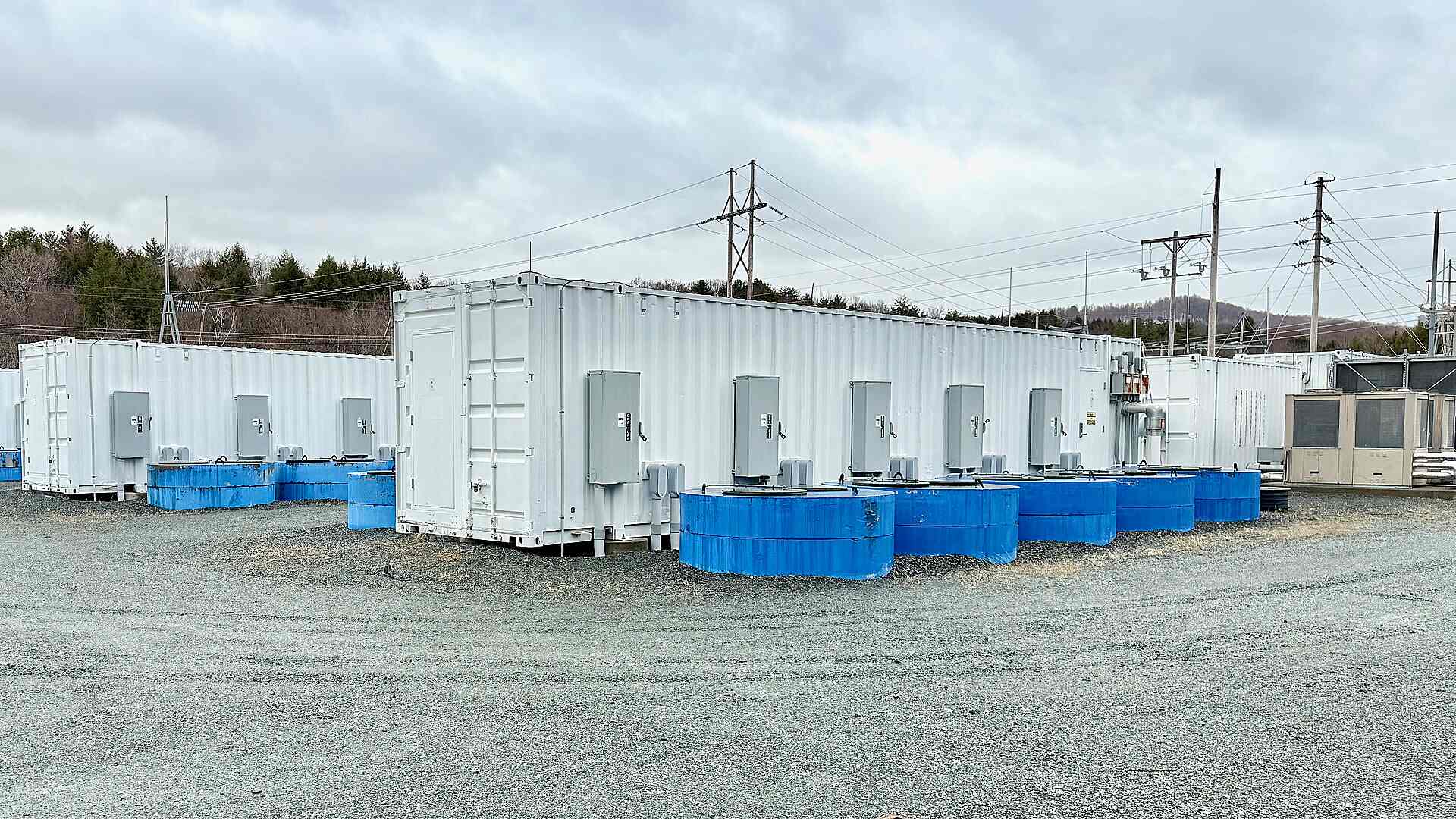
Hero photo: “Beacon Power New York – 20 MW Flywheel Energy Storage” via Wikimedia Commons, CC BY-SA 4.0 (cropped to 16:9). Shown for the containerised storage enclosure form factor.