


For most of the past decade a grid-forming BESS was a showcase item: specified for a handful of flagship projects to prove the concept worked, while the rest of the market bought power conversion that simply followed whatever the grid was doing. In the final quarter of 2026 that stopped being true: grid-forming capability is now appearing inside binding connection rules, national construction standards and utility-scale scopes of work.
Need a storage supplier who answers with numbers?
We ship LiFePO4 storage batteries and BESS for utility-scale, C&I and residential
projects worldwide — with cell-level specs, cycle-life data and landed-cost
transparency on Grid-Forming BESS. Send us your capacity, duration and delivery window,
and we will reply with a real quotation, not a brochure.
Why Grid-Forming BESS Finally Moved From Pilot to Prerequisite
The physics drove it. Every retired coal or gas unit removes rotating mass from the system, and rotating mass is what has historically held frequency steady. Solar and wind contain no spinning mass at all, and until recently the batteries meant to compensate for that loss were configured to follow the grid’s voltage and frequency rather than to establish it. A grid-following converter cannot create a reference signal, cannot push fault current fast enough to satisfy a protection scheme, and cannot start a dead network.
Grid-forming converters invert that logic. They hold an internal voltage reference the way a synchronous machine does, inject fault current within sub-cycle timescales, and operate stably on weak networks where the short-circuit ratio (SCR) is low. In markets with high renewable penetration and long transmission distances, that is increasingly the difference between a connection agreement and a rejection letter.
India Writes Grid-Forming Into the Connection Rules
The most explicit move came from India’s Central Electricity Authority. On 31 July 2026 the CEA issued the draft Technical Standards for Connectivity to the Grid Regulations, 2026, replacing standards written in 2007 when the grid was dominated by synchronous plant. The draft applies to everything connecting at 33 kV and above and proposes that BESS of 50 MW and larger carry automatic generation control, grid-forming inverter capability and black-start capability, alongside voltage and frequency ride-through, power plant controllers, ramp-rate control and night-mode operation. It also proposes that no generator receives connectivity without a Unique Registration Number issued through the CEA’s e-GEN portal, and empowers the authority to order disconnection until non-compliance is corrected, with separate action available under Section 146 of the Electricity Act, 2003. The comment window closed on 2 September 2026 (King Stubb & Kasiva; Mondaq).
A second CEA draft notified on 3 September 2026 goes further, making storage a condition of construction rather than an option. Ground-mounted solar and onshore wind commissioned from 1 July 2027 would have to include co-located storage equal to at least 10% of installed capacity with a minimum two-hour discharge; between July 2029 and June 2031 the duration requirement doubles to four hours. The draft also requires at least 15% of a project’s inverters to use grid-forming control, and every power conversion system inside the storage block to carry the same capability. Comments are open to 4 October 2026 (Jevanta Renewables).
At state level the same logic is reaching tariffs. Kerala’s KSERC has issued draft Multi-Year Tariff Regulations for the 2027–2032 control period mandating grid-forming inverters on new BESS, with stable operation required at an SCR of 2.0 or below, plus a normative 85% cycle efficiency for storage and a 20-paise incentive for exceeding it. Hearings were set for 29–30 September 2026.
Grid-forming requirements tracker — what changed in Q3 2026
| Market | Instrument & date | Status | What it demands |
|---|---|---|---|
| India (national) | CEA draft Technical Standards for Connectivity to the Grid Regulations, 2026 — issued 31 Jul 2026, comments closed 2 Sep 2026 | Draft, not yet notified | BESS of 50 MW and above to carry AGC, grid-forming inverter capability and black-start; applies to connections at 33 kV and above; e-GEN registration number required |
| India (construction) | CEA 2nd Amendment Regulations draft — notified 3 Sep 2026, comments to 4 Oct 2026 | Draft | From 1 Jul 2027: co-located storage ≥10% of installed capacity, ≥2h discharge; 4h from 2029; at least 15% of inverters grid-forming and every storage PCS grid-forming |
| India (Kerala) | Draft KSERC Multi-Year Tariff Regulations 2026 — public hearing 29–30 Sep 2026 | Draft; control period opens 1 Apr 2027 | Grid-forming inverters mandatory for new BESS; stable operation at short-circuit ratio of 2.0 or below; 85% normative cycle efficiency with a 20-paise incentive |
| Great Britain | GC0137 Grid Code specification; NESO Markets Roadmap | Grid Code specification issued; not yet mandatory | World-first formal grid-forming specification; grid-forming batteries projected to supply about 12% of contracted inertia in 2026 |
| Europe | ENTSO-E grid-forming requirements for power park modules; Elia consultation; German TSO inertia procurement rounds | In development or consultation | Pan-European technical requirements for grid-forming power park modules rather than project-by-project specifications |
| United States (ERCOT) | Operating Guide §2.14 and Planning Guide §6.2; Dynamics Working Group Procedure Manual §3.1.5 | Adopted; separate ride-through reliability standard effective 1 Oct 2026 | Grid-forming storage performance, models, studies and verification; plant-level ride-through demonstrated by simulation at the point of interconnection |
Supernode: What Grid-Forming Looks Like at 780 MW
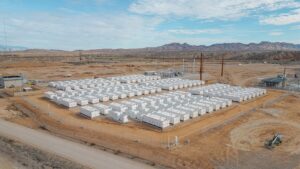
Australia is where the engineering is being proven at scale. GE Vernova has been selected by Quinbrook for Stage 3 of the Supernode battery energy storage system in Queensland, making it the sole provider of power conversion, plant controls, system integration and grid-connection support across all three stages of the campus. Stage 3 adds 260 MW and 1,216 MWh of four-hour storage, taking the full site to 780 MW and 3,075 MWh. Stages 1 and 2 — already operational on GE Vernova technology — supplied the first 520 MW and 1,858 MWh (GE Vernova; Quinbrook).
Two details matter more than the headline figures. First, Stage 3 is GE Vernova’s first grid-forming battery project in Australia, and it secured Generator Performance Standards (GPS) acceptance — the agreed technical benchmarks for connecting to the National Electricity Market — before construction was completed. Demonstrating plant-level behaviour rather than converter-level capability is materially harder. Second, the site sits next to the South Pine switchyard, the hub through which roughly 80% of Queensland’s electricity flows. Quinbrook Senior Director James Allan has said the site retains capacity for a further 520 MW of expansion, “which could include battery storage, data centres or a combination of both.” Ed Torres of GE Vernova’s Electrification segment framed the shift directly: “Battery storage is becoming part of the operating foundation of modern electricity systems.” CATL supplies its TENER S system for the Stage 3 blocks (Energies Media; Ethical Marketing News).
Elsewhere the direction is the same but the instruments differ. Great Britain became the first system operator in the world with a formal Grid Code specification for grid-forming capability when it introduced GC0137, and grid-forming batteries are projected to supply roughly 12% of GB’s contracted inertia during 2026, with NESO pushing procurement toward commercialised day-ahead and year-ahead stability markets. ENTSO-E is preparing pan-European grid-forming requirements for power park modules, Finland already treats the capability as necessary in certain BESS connections, and German transmission operators have opened inertia procurement rounds. In ERCOT the requirements now sit in Operating Guide §2.14 and Planning Guide §6.2, with a separate ride-through reliability standard for inverter-based resources taking effect on 1 October 2026 (ESIG; VSS Power).
What Grid-Forming Changes in Project Engineering and Cost
Grid-forming is not a firmware flag. It changes how the surrounding plant is designed and how much of the battery is available for revenue, because converters that must inject fast fault current have to reserve headroom (VSS Power).
Where grid-forming changes the engineering scope
| Design area | Grid-following baseline | Grid-forming implication |
|---|---|---|
| Converter duty | Tracks existing grid voltage and frequency | Establishes its own voltage reference and must reserve headroom, and reserved headroom is capacity that cannot be sold into the energy market |
| Fault behaviour | Modest fault current, often modelled with a generic converter assumption | Fast fault current injection means transformer and switchgear fault ratings must reflect the inverter’s actual current contribution |
| Protection | Overcurrent relays set for synchronous fault characteristics | Protection coordination studies have to be re-run around the inverter’s fault signature |
| Substation and SCADA | Standard RTU polling cycles | BESS controller to substation SCADA link must handle sub-cycle response times older RTUs were never specified for |
| Compliance evidence | Converter-level datasheet | Plant-level acceptance under a grid code or GPS process; IEC 62477, IEC 61400-21, IEEE 2800 and BS EN standards cited in export contracts |
| Grid strength | Assumes an adequate short-circuit ratio | Must remain stable at a short-circuit ratio of 2.0 or below under the Indian draft rules, so weak-grid behaviour becomes a design case rather than an edge case |
Cost context matters. InfoLink’s 23 September 2026 assessment put the average Chinese 314Ah LFP storage cell at RMB 0.365/Wh with lithium carbonate at RMB 132,000 per tonne — more than 20% above the late-2025 trough, and China’s 2% lithium-ion consumption tax steps up to 4% on 1 September 2027. Grid-forming hardware sits on top of that base. Against it, SNE Research reported global lithium-ion storage shipments of 461.3 GWh in the first half of 2026, up 71% year on year (InfoLink Consulting; SNE Research).
What Buyers Should Write Into a 2026–2027 Storage Specification
Four things. Specify grid-forming in the power conversion scope, not as an optional upgrade. Require the minimum short-circuit ratio the plant must remain stable at, and name the grid code or guidance note the plant will be validated against. Keep protection coordination, transformer fault ratings and SCADA integration with the same party that supplies the power conversion, because that interface is where grid-forming projects fail. And make plant-level acceptance evidence a milestone in the contract rather than a promise at handover.
NEGUP Energy builds storage to that specification set. Our containerized BESS and utility-scale BESS platforms are configured by discharge duration, short-circuit ratio and duty cycle, and the same engineering discipline applies to commercial & industrial ESS and residential ESS.
Talk to NEGUP Energy about a storage system specified for grid-forming connection requirements.
WhatsApp +86 15307690902 | rain@negupgroup.com
SCR 2.0 requirement
85% cycle efficiency
10% storage mandate 2027
780MW Supernode
Grid-Forming BESS: Questions Buyers Ask Before Ordering
1. Grid-forming capability is becoming mandatory. Does that change which batteries we should buy?
It changes the specification, not the cell chemistry. The draft requirements target anything connecting at 33kV and above, with BESS of 50MW and above carrying AGC, grid-forming inverter capability and black-start. That is a PCS and control requirement. Cells are largely unchanged, so you can specify a standard LFP product and satisfy the grid code through the inverter layer.
\n
2. How does a storage mandate affect co-located projects?
From 1 July 2027, co-located storage must be at least 10% of installed capacity with at least a 2-hour discharge, rising to 4 hours from 2029, and at least 15% of inverters must be grid-forming with every storage PCS grid-forming. That is a design freeze deadline rather than a future option. If your project commissions after July 2027 you must design to this now.
\n
3. Will the 85% normative cycle efficiency requirement cut our revenue?
It sets a floor rather than a ceiling, and there is an incentive attached — a 20-paise reward for meeting it. Real systems that must also provide inertia and black-start will land near this number, so model 85% in your dispatch assumptions and treat anything above as upside. Underwriting below 85% is the risk, not underwriting exactly 85%.
\n
4. What does grid-forming actually look like at grid scale?
Proven at 780MW. GE Vernova was selected for Stage 3 of the Supernode battery energy storage system in Queensland, adding 108.4MW/215.6MWh of grid-forming capability to a larger complex. The engineering question is stability at low short-circuit ratios, with a requirement for stable operation at SCR of 2.0 or below. That is a controls and validation exercise; the hardware is largely standard.
Still weighing options? Send your project detail on WhatsApp
and we will reply with a written answer,
or email rain@negupgroup.com.