

Need a storage supplier who answers with numbers?
We ship LiFePO4 storage batteries and BESS for utility-scale, C&I and residential
projects worldwide — with cell-level specs, cycle-life data and landed-cost
transparency on BESS for Coal-Exit and Congestion. Send us your capacity, duration and delivery window,
and we will reply with a real quotation, not a brochure.
Storage Stops Being a Side Project and Starts Replacing Retired Capacity
For most of this decade, grid-scale batteries were described as supporting assets: they smoothed renewables, won frequency-response contracts and earned arbitrage spreads around the edges of a system still anchored by thermal generation. The news cycle of 21–22 September 2026 marks a different role. Projects announced and energised this week were justified in the language of replacement and relief — substituting for coal going offline, or unlocking grid capacity frozen by congestion. That shift matters for anyone procuring battery energy storage systems, because replacement assets carry capacity obligations, availability guarantees and multi-decade service commitments that merchant ones do not.
Nova Scotia: Three Batteries, One Coal Deadline
Nova Scotia Power inaugurated three 50 MW/200 MWh battery systems at Bridgewater, Waverley and White Rock — 150 MW/600 MWh total and now the largest battery fleet in Atlantic Canada. The utility cites grid resilience and renewable integration; the strategic purpose is sharper. Nova Scotia is legislated to reach 80% renewable electricity and go off coal by 2030, and batteries are how the province holds reliability while coal units retire. (Energy-Storage.News, 22 Sep 2026)
The funding structure matters for smaller, higher-cost markets. The federal government contributed CAD 109 million and the Canada Infrastructure Bank provided a CAD 138.2 million loan, and the portfolio was developed with Wskijinu’k Mtmo’taqnuow Agency Ltd, representing the province’s 13 Mi’kmaw communities — an equity model increasingly prerequisite for Canadian infrastructure.
The Netherlands: A Battery Paid to Relieve Congestion
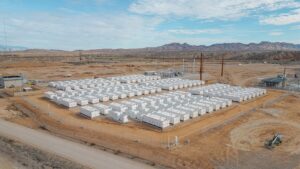
RWE took a final investment decision on a 400 MW/1,100 MWh battery at its Moerdijk power station site in Noord-Brabant — 208 lithium-ion containers delivering full output for almost three hours, commissioning planned for Q2 2028, connected through the plant’s existing substation. (RWE, 21 Sep 2026)
The commercial mechanism, not the capacity, is the story. Under capacity steering agreements with transmission system operator TenneT, the battery will be dispatched specifically to relieve congestion in Noord-Brabant, freeing grid space for parties on the connection waiting list. TenneT and regional operator Enexis will factor it into a congestion-management study in December 2026. The asset will also provide instantaneous reserve (inertia). This template is spreading across congested European networks: the battery is paid for the grid capacity it releases, and that revenue is contractual rather than speculative. RWE operates roughly 1.7 GW of battery storage globally with a further 3 GW under construction.
Benelux, Finland and Arizona: FIDs Are the Only Real Signal
Giga Storage began construction on Green Turtle in Belgium, a 700 MW/2,800 MWh system — among Europe’s largest — with 640 of Tesla’s LFP Megapack 3 units under a full EPC wrap and commissioning scheduled for March 2028. Grid operator Elia is building a new high-voltage substation on the site. (Energy-Storage.News, 22 Sep 2026)
In Finland, Covenergo and Delta Capacity began construction on AKKU One, a standalone 125 MW/300 MWh system in Lapinlahti, targeting commissioning in Q4 2027. In the United States, GridStor closed a US$220 million tax equity bridge, construction and term debt facility for its 100 MW/400 MWh White Tank project in Maricopa County, Arizona, with ING Capital, KeyBank and Zions Capital Markets; it carries a 20-year tolling agreement with Arizona Public Service and is expected in service in H1 2027. APS recorded a peak demand on 2 August 2026 that was 5% above its previous record, driven by population growth, semiconductor manufacturing and data centres. (GridStor, 9 Sep 2026; ESS News, 22 Sep 2026)
The distinction that matters across all four cases is final investment decision. Announced pipelines routinely run several times larger than what is actually built; an FID is the point at which capital is committed and containers are ordered.
| Project | Market | Power / Energy | Primary contracted function | COD |
|---|---|---|---|---|
| Bridgewater / Waverley / White Rock (Nova Scotia Power) | Canada | 150 MW / 600 MWh | Coal exit, reliability, renewable integration | 2025–2026 |
| Moerdijk (RWE) | Netherlands | 400 MW / 1,100 MWh | Congestion relief via TenneT steering agreements | Q2 2028 |
| Green Turtle (Giga Storage) | Belgium | 700 MW / 2,800 MWh | Peak shifting, nuclear-exit adequacy | Mar 2028 |
| AKKU One (Covenergo / Delta Capacity) | Finland | 125 MW / 300 MWh | Standalone grid services | Q4 2027 |
| White Tank (GridStor) | USA — Arizona | 100 MW / 400 MWh | 20-year tolling agreement with APS | H1 2027 |
India: Viability Gap Funding Turns Storage Into a Bankable Contract
India showed how emerging markets can manufacture bankability without waiting for merchant spreads to mature. Oriana Power received two letters of award from Maharashtra State Electricity Distribution Company (MSEDCL) on 18 September 2026 for 900 MW/1,800 MWh of BESS, worth about INR 3,870 crore, split into 500 MW/1,000 MWh at INR 238,000 per MW per month and 400 MW/800 MWh at INR 240,000 per MW per month. Both operate under 15-year Battery Energy Storage Purchase Agreements; GK Energy won a further 150 MW/300 MWh at the same lower tariff. (Business Standard, 21 Sep 2026; Saur Energy; HDFC Sky, 22 Sep 2026)
The awards came through tariff-based global competitive bidding with an e-reverse auction, supported by Viability Gap Funding under the Power System Development Fund — Oriana expects roughly INR 324 crore of VGF — and Oriana took 45% of MSEDCL’s tendered 2,000 MW/4,000 MWh. For suppliers and EPCs, the operative detail is that these are 15-year purchase agreements with fixed monthly tariffs: revenue certainty a merchant battery cannot offer, and the reason Indian standalone storage is attracting contractors who previously avoided the sector.
Supply Chain: A 206 GWh Framework, and What It Actually Commits
The largest supply-side announcement of the week was EVE Energy’s framework agreement with system integrator Fluence, covering up to 206 GWh of battery deliveries from 2027 to 2031 — 16 GWh committed for 2027 and 190 GWh reserved for 2028–2031. EVE shipped 44.46 GWh of energy-storage batteries in the first half of 2026, up 54.9% year on year. (EVE Energy Shenzhen filing, 18 Sep 2026; Energy-Storage.News; The Paper, 19 Sep 2026)
Two caveats belong in any honest reading. First, reserved capacity is not a purchase order: specifications, prices, delivery schedules and manufacturing locations will be set in later orders, and EVE itself noted the framework is subject to change from policy or market conditions. Second, the deal sits against Fluence’s revised FY2026 guidance, which cut forecast revenue by US$600 million and widened its expected EBITDA loss to near US$200 million, attributed mainly to delays in its US manufacturing ramp-up — a consequence of tariffs on Chinese batteries and Foreign Entity of Concern rules that bar projects using Chinese battery technology from clean-energy tax credits. The framework therefore presumably covers non-US projects. Fluence retains a US$6.4 billion order backlog.
For buyers, the lesson is that headline gigawatt-hours and deliverable capacity are different quantities. A framework secures allocation; it does not secure a qualified configuration, a tested cell format or a service arrangement. Those still have to be validated project by project.
Where the Volume Actually Came From in August
Benchmark Mineral Intelligence data released on 22 September shows 6,516 MW/20,855 MWh of grid-scale BESS entering commercial operation globally in August 2026 — nearly 21 GWh. China accounted for 61%, Saudi Arabia 19%, Europe 11%, and South and Central America just under 5%. (Energy-Storage.News, 22 Sep 2026)
That distribution explains why western project news and global volume numbers diverge so sharply. Nearly a fifth of August’s global commissionings were Saudi, reflecting the Kingdom’s batch procurement model; Europe, despite a dense pipeline of FIDs, delivered about a tenth of the month’s total. Build-out is no longer one global trend but several regional cycles running at different speeds.
What This Means for Storage Procurement in 2027
Three implications stand out. First, contracted function is replacing merchant revenue as the basis of finance: tolling agreements, congestion-relief steering agreements and capacity purchase agreements are now the structures lenders underwrite. Second, grid connection — not cell supply — is the binding constraint in most mature markets, which is why projects that free up capacity rather than consume it command a premium. Third, supply frameworks are consolidating around a handful of cell makers, and the FEOC and tariff divide is splitting the world into separate qualified supply chains.
For buyers of C&I and utility-scale ESS, the defensible position is to specify against qualified configurations with documented safety and service terms, and to read framework headlines as an indicator of allocation rather than a guarantee of delivery. India’s VGF-backed tenders and Europe’s congestion-relief contracts point the same way: the projects built in 2027 will be those with a named counterparty, a fixed term and a defined system obligation.
Contact: WhatsApp +86 15307690902 | info@negupgroup.com
400MW / 1,100MWh Moerdijk
206 GWh framework
700MW / 2,800MWh Belgium
125MW / 300MWh AKKU One
BESS for Coal-Exit and Congestion: Questions Buyers Ask Before Ordering
1. What is capacity steering and why is it a better contract than merchant?
Under capacity steering agreements with the transmission system operator, the battery is dispatched specifically to relieve congestion rather than to chase price, so the revenue is a contracted service payment instead of a merchant spread. A 400MW/1,100MWh battery at a Dutch power station site is on exactly this structure. The trade-off is a one-sided contract: winners typically return roughly 90% of merchant profit above the contracted payment.
\n
2. Can a standalone battery earn a return with no generation or load attached?
Yes, in congestion-driven and capacity markets. A 125MW/300MWh standalone system in Finland targeting Q4 2027 commissioning is one example, and a 700MW/2,800MWh Belgian project under a full EPC wrap is another. The requirement is a clear grid-services revenue line, which is why these projects work in high-congestion networks and not everywhere. Site selection is the whole project.
\n
3. What does a 206GWh cell framework actually commit suppliers to?
Volume, and that cuts both ways. The framework between EVE Energy and an integrator covering up to 206GWh from 2027 to 2031 gives the buyer visibility on allocation and the supplier visibility on demand, but a framework is not a firm order. Secure your place by getting onto the allocation list with a signed technical specification, not by being in the press release.
\n
4. How long does a multi-hundred-MWh BESS take to deliver, realistically?
Longer than the announcement cycle suggests, because 208 lithium-ion containers at one site is a full production slot, not a stock order. Plan on quarters, and align your grid-connection milestone with the delivery schedule rather than assuming the two can be compressed. Tell us your required in-service date and we will be honest about which quarter we can commit a containerised block to.
Still weighing options? Send your project detail on WhatsApp
and we will reply with a written answer,
or email rain@negupgroup.com.